
New Zealand Reach 368 Against India as Nicholls Finishes Unbeaten on 175
New Zealand made 368 in their first innings against India at Wellington, with Henry Nicholls unbeaten on 175 and Glenn Phillips contributing 118. The hosts’ recovery from 70/5 gave the innings a very different shape from its early collapse. Jasprit Bumrah finished with four wickets, while Akash Deep took three.
The innings was completed on the second day of the first Test, 20 November 2026, at the Basin Reserve. This report examines that completed innings. It is not a final match result or a continuously updating account of India’s reply.
Nicholls and Phillips supply most of the runs
PTI’s second-day scoreboard records Nicholls on 175 not out and Phillips on 118. Their combined contribution was 293 runs, or just under four-fifths of New Zealand’s total.
The fall-of-wickets record shows the fifth wicket falling at 70 and the sixth at 286. That makes the sixth-wicket partnership worth 216 runs. It was the central recovery stand, taking New Zealand from a vulnerable position to a score with a much stronger base.
Those numbers also explain why a headline about an early Indian breakthrough and one about a New Zealand recovery can both describe the same innings accurately. The story changed substantially between the fifth and sixth wickets.
How the early wickets shaped the innings
Tom Latham was dismissed without scoring, Devon Conway made four, Rachin Ravindra 15, Daryl Mitchell one and Tom Blundell five. With five wickets down for 70, New Zealand needed a partnership that could change the structure of the innings rather than a brief burst of scoring.
Nicholls’ unbeaten finish mattered because his contribution extended beyond the main stand. When Phillips was dismissed, New Zealand still had another 82 runs to add before reaching 368. The final total therefore reflects both the major partnership and the additional work after it ended.
This is a distinction between a partnership’s value and an individual’s complete innings. Adding the two main batters’ scores describes their total contribution, while subtracting the fifth-wicket score from the sixth-wicket score identifies the runs added together at that stage.
India’s wicket-taking returns
The scorecard gives Bumrah 4/92, Akash Deep 3/53, Anshul Kamboj 2/69 and Prasidh Krishna 1/100. Washington Sundar’s figures were 0/45. New Zealand’s innings lasted 121 overs.
Mint’s report on Akash Deep’s dismissal of Kyle Jamieson records Jamieson making 11 from 21 balls and also confirms New Zealand’s 368 total. That wicket was part of India’s work in ending the innings after the long middle-order recovery.
For the overall picture, keep the complete bowling figures alongside the individual dismissal clips. A short video can show how one wicket fell, while the scorecard establishes each bowler’s contribution over the full innings.
The scoreboard also includes 20 extras. They count towards the team total but not either batter’s personal score, another reason to keep the partnership, individual scores and full innings total as separate figures.
What the completed total means for following the Test
The BCCI’s official match feed also recorded New Zealand’s completed total as 368 as India began their response. The useful next comparison is between the teams’ first-innings totals, followed by the lead or deficit when that stage is complete.
A first-innings score alone does not establish who will win a Test. Conditions, the reply and the remaining innings still determine the match. Treat the completed New Zealand figures as a fixed reference point while using the official scorecard for developments that happen afterwards.
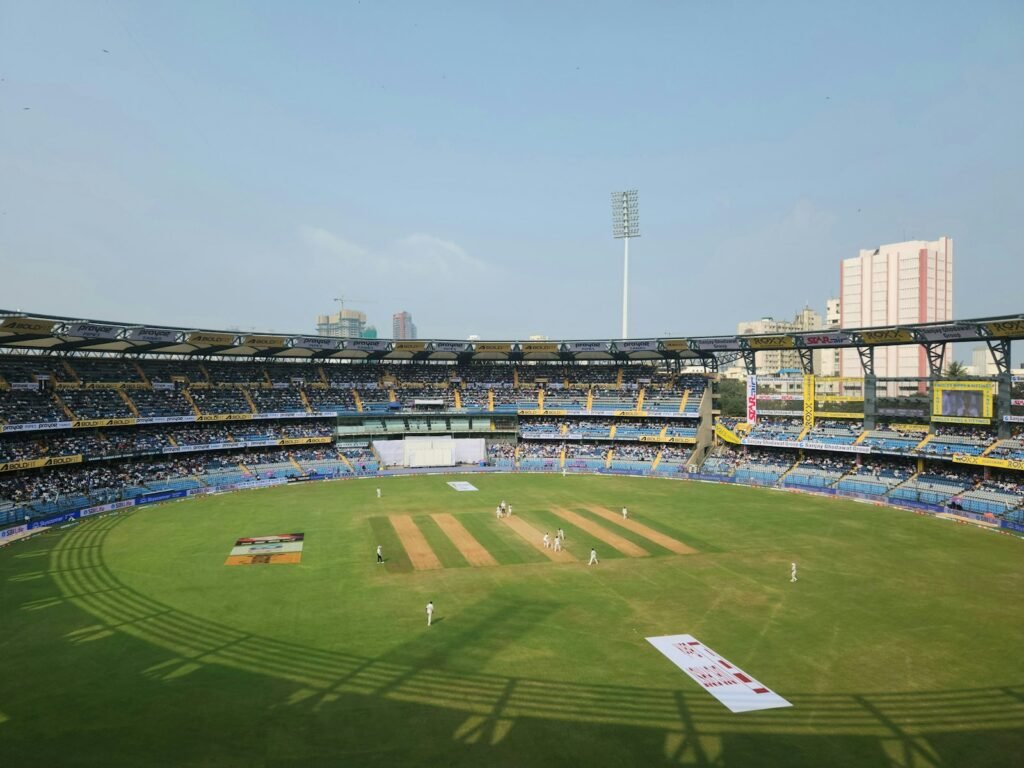
The clearest summary of this innings is the contrast between 70/5 and 368 all out: India created an early opening, and Nicholls and Phillips supplied the substantial recovery. The photograph illustrates a cricket ground and is not a picture from this Wellington Test.