Voyager 1 Is One Light-Day Away: Why Its Signal and Its Data Are Different
Voyager 1 has reached one light-day from Earth, meaning its radio signals now need about 24 hours to cross the distance in one direction. NASA announced confirmation on 19 November 2026, after the spacecraft reached the milestone on 18 November. The achievement comes with an important distinction: the team can detect the probe’s carrier signal even while science and engineering data are missing.
NASA’s Jet Propulsion Laboratory announcement puts the distance at roughly 16.1 billion miles, or 25.9 billion kilometres. For readers following headlines about both a communications problem and a historic distance, these are compatible developments rather than contradictory reports.
A light-day measures distance
A light-day is the distance light travels in 24 hours. It is not the distance Voyager covers in a day, and it does not mean the spacecraft has suddenly accelerated. The mission has been travelling since its 1977 launch.
NASA’s mission-position page placed the threshold at 2:16:07 a.m. Pacific Standard Time on 18 November. That corresponds to 3:46:07 p.m. IST the same day. The announcement followed after the signal made its journey back to Earth.
That timing helps explain why one report can describe a milestone on Wednesday while another celebrates confirmation on Thursday. The physical event and the arrival of information about it happen on different dates when the communications delay is this long.
A carrier signal is not the same as returned measurements
In a separate 18 November engineering update, NASA said the mission team became aware on 14 November that the spacecraft had stopped returning science and engineering data. A Deep Space Network antenna in Canberra could receive a carrier signal, but the expected data were absent.
The team said the carrier and trajectory calculations would still allow the light-day distance to be confirmed. A spacecraft’s known path does not disappear when a data stream develops a problem. Equally, detecting a radio carrier does not establish that all the instruments and engineering reports are functioning normally.
The update says engineers are investigating whether the problem is connected with a brief communications gap in October. It does not announce a confirmed cause or a completed repair. Readers should therefore keep the successful distance confirmation separate from any claim that the data issue has been resolved.
What a 24-hour delay means for troubleshooting
At this distance, a command sent from Earth cannot produce an immediate reply. The outward signal takes about a day, and a returning signal takes another day. A simple command-and-response exchange therefore involves roughly two days of travel time before allowing for the spacecraft’s work or ground operations.
Imagine sending one carefully chosen diagnostic instruction and then waiting to see what it reveals. If that result suggests another instruction, the next exchange carries the same distance penalty. This is why an engineering investigation can progress slowly even when a team understands exactly which question it wants to ask next.
That example explains the delay; it is not a description of a particular repair sequence currently being attempted. NASA’s published updates remain the place to check what engineers have actually tried and learned.
The milestone and the next update to watch
Voyager 1 entered interstellar space in 2012, beyond the heliosphere, the bubble shaped by the Sun’s particles and magnetic field. Its twin Voyager 2 crossed that boundary in 2018. The new light-day marker describes distance from Earth, rather than a newly crossed physical boundary in space.
The next useful operational update will concern the return of readable engineering and science data, or a clearer explanation of why they stopped. Until then, the confirmed achievement is the distance milestone and receipt of the carrier signal used to verify it.
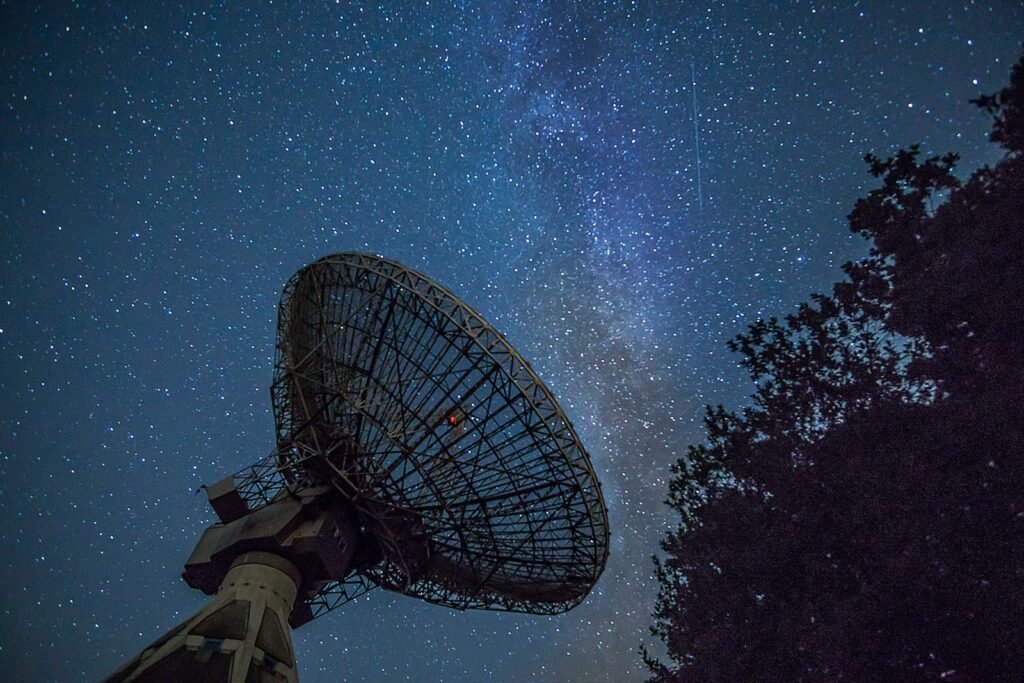
The featured photograph illustrates a ground-based radio antenna. It does not show Voyager 1 or identify a particular NASA tracking station.