XREAL AURA Android XR Glasses: Features and Limits
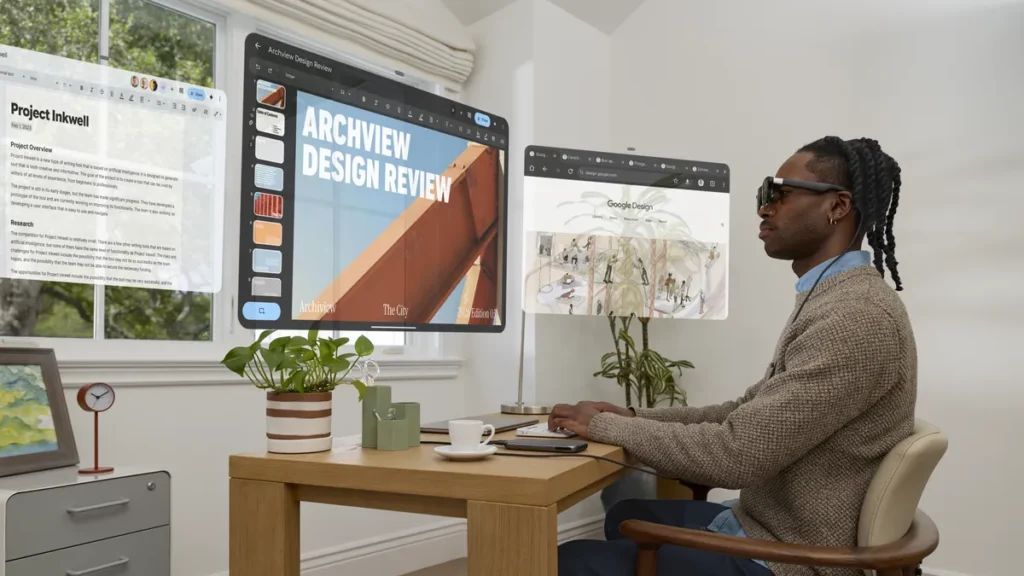
XREAL AURA Android XR glasses are a new option for people interested in a wearable display that keeps the surrounding world visible. Google’s 28 October 2026 announcement describes a wired design powered by a separate compute puck. That architecture matters: these are not simply ordinary glasses with a small screen, and they should be evaluated as a complete device system.
What is officially announced
Google’s XREAL AURA announcement identifies AURA as the first wired Android XR glasses. It describes a 70-degree field of view, glasses weighing under 95 grams and a compute puck using Snapdragon Reality Elite.
The announcement also describes transparent lenses, Gemini integration, multiple app windows, keyboard and mouse use, and USB-C video mirroring. Orders were announced for the US, Canada and South Korea on 28 October, with Japan following on 2 November. This announcement does not establish an Indian launch.
These are manufacturer-provided specifications and launch details. They do not establish how comfortable the glasses feel on every face or how well every application behaves in extended use.
Why the separate compute puck matters
Moving processing into a separate component changes how you carry and connect the product. Before buying, think through where the puck would sit, how the cable would run and whether that arrangement fits your normal working position.
For a desk user, the cable may be easier to accommodate than for someone moving frequently between rooms. Neither use case can be judged from a specification sheet alone. A short demonstration should include standing, sitting and turning your head naturally, rather than only looking straight ahead.
Ask what is included in the box and which cables or adapters are required for your intended setup. A working demonstration using one computer does not prove that every laptop port supports the same connection.
Can the glasses replace a monitor?
A virtual workspace may be attractive if you want several windows without carrying a full-size display. The useful test is whether your normal work remains readable and comfortable, including small text, menus and the applications you use most.
Try a realistic task rather than only a cinematic demonstration. Read a document, compare two windows and type a paragraph. Notice whether you can locate controls naturally and whether repositioning the workspace feels straightforward.
Do not assume a wide field of view means every window remains visible at once. Window size, placement and the way you move your head all influence the experience. A conventional monitor and wearable display also place different demands on your working habits.
AI features need their own checks
Gemini integration is part of the announced experience, but it should not be interpreted as a promise that every account, language or task has identical support. Check the current feature documentation and the account requirements in your market.
For work use, consider what information an assistant can access and whether your employer permits that use. A product demonstration involving personal content is not a substitute for an organisation’s data policy.
Start with a low-risk task when testing a new assistant interface. Confirm the result on the original screen or document before relying on it for anything consequential. Convenience is valuable when it reduces effort without making verification harder.
What Indian buyers should confirm
There is no verified Indian price or official Indian availability date in the announcement covered here. Importing adds questions about warranty, service, prescription compatibility and returns. Currency conversion alone does not answer those questions.
Ask for a demonstration with your own intended computer or phone where possible. If that is unavailable, avoid treating a broad compatibility claim as proof of your exact setup.
XREAL AURA is best understood as a transparent, wired Android XR system with a separate computing component. Readers considering a more conventional portable screen can also compare the new OLED iPad mini announcement, while keeping each product’s different purpose in view.